



Spotify is to label artists with AI identities and exclude them from algorithm recommendations with its new Artist Persona tag but AI generated songs can still escape the badge.
Spotify announced yesterday that it will begin applying an AI Persona badge to artist profiles from mid-September, the platform’s most direct move yet on the flood of AI music to date.
Artists can now self-disclose through Spotify for Artists that their profile represents an AI Persona. Spotify says it won’t rely on that alone, and will also review profiles itself and apply badges where it decides a public identity is artificial.
The badge will appear in the profile banner and About section, in search results, and on track rows inside playlists. Tapping it will tell listeners whether the artist disclosed voluntarily or whether Spotify’s review team made the call.

Badged profiles are excluded by default from editorial and algorithmic recommendations, so an AI Persona shouldn’t turn up in Discover Weekly or a Spotify-curated playlist unless you have followed it directly which is a very good thing.
♡ Nialler9 is independent and reader-supported. Support us on Patreon →
Artists badged without disclosing are notified and can appeal. In the coming months, Spotify says listeners will also be able to report profiles they suspect are AI Personas.
It sounds like the labelling system critics have been asking Spotify for since The Velvet Sundown racked up its first million plays. So this solves most of the problem with AI-generated music right?
Wait, There is an issue
The issue is down to Spotify’s decision to focus not on the music but the artist profile. AI personas only applies to the profile picture the artist is using not the actual music – AI generated or not – that is the criteria addressed by other streaming services.
Spotify’s answer to the “how was it made” question is its existing AI Credits system, which is voluntary, and SongDNA, which is a credits and contributor tool rather than a detection tool.
“This badge is about the artist’s public identity, not about how the music was made. “
Spotify
Deezer tags both the artist and the track
Compare that to what Deezer has been doing since June 2025. Deezer tags the track, using detection rather than disclosure, and it has been publishing the numbers: over 13.4 million AI tracks detected and tagged in 2025, more than 60,000 arriving daily, roughly 39% of everything delivered to the platform.
Spotify’s badge does not detect a single one of those songs. It detects whether the profile picture looks like a person who doesn’t exist.
Using ‘Rubberz’ as an example
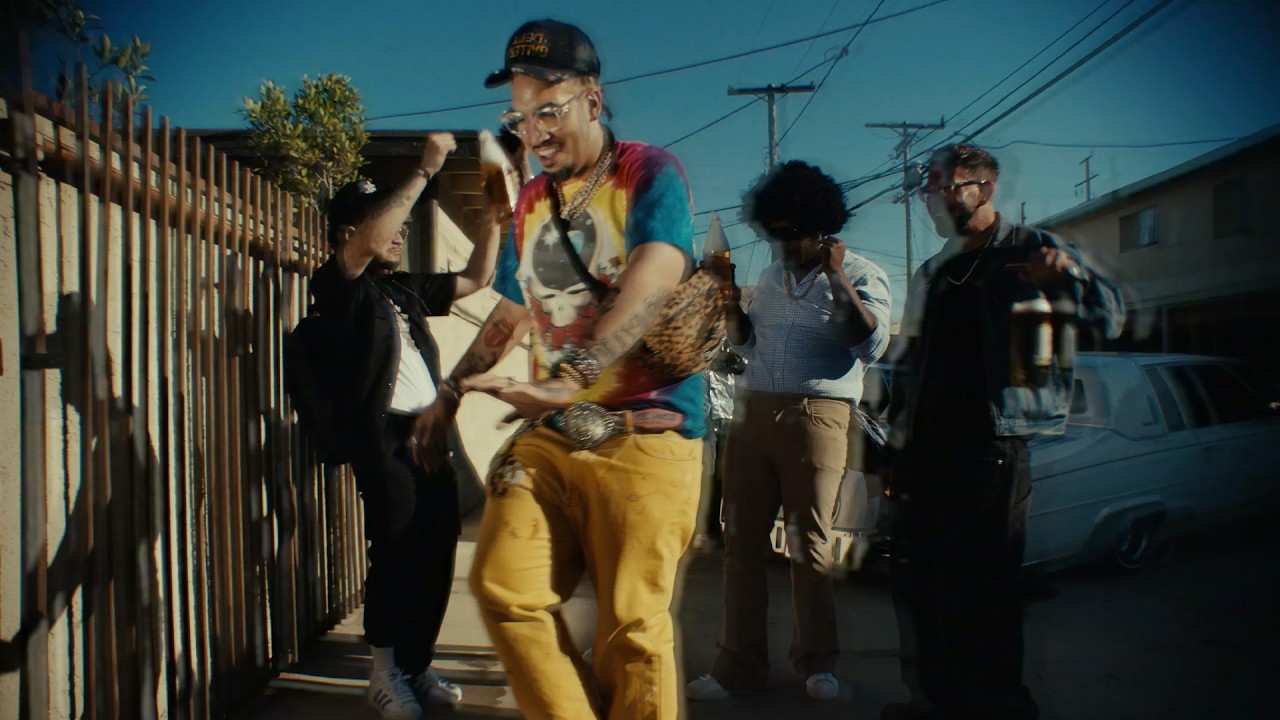
Here’s a real world example – a song of the summer contender if you will.
Fenix Flexin, the Shoreline Mafia rapper, released ‘Rubberz’ on Friday June 5th, a synth-pop track with a British-accented vocal a long way from his West Coast rap catalogue. It went viral and got called the song of the summer.

Accusations that it was AI-generated started almost immediately. Listeners pointed out that the vocal didn’t sound like him, that it hit notes he’d never demonstrated in a decade of releases, and that the genre was one he’d never attempted. Timbaland, one of the industry’s loudest AI evangelists, came to his defence, which helped nobody.
Fenix denied it for two months, as did his producer Purps On The Beat. He told one commenter the track was recorded the same as all his music, with the only additions being Auto-Tune, reverb and a fake UK accent. Asked directly in an interview whether there was AI on the song, he said there wasn’t.
Then the producer Medasin published a forensic breakdown pointing to Treblo, the generative platform formerly known as Sonauto. Fenix responded with a video walking through a Pro Tools session with the song split into stems, apparently as proof he’d built it by hand. Medasin and others noted you can get the same result by running a finished AI track through a stem splitter. The video was deleted.
The Verge ran its own analysis and found artefacts and anomalies common to AI-generated music: brittle hi-hats, chorus vocals with the character of a low-bitrate MP3, reverb tails cutting off unnaturally. Charlie Harding of Switched On Pop tied that degradation to training data, arguing the audible mush comes from models trained on low-quality MP3s of unlicensed copyrighted material.
Treblo’s co-founder then said the song had been made on the platform, and the company’s own detection tool flagged it, though that tool’s accuracy hasn’t been independently verified.
On Friday August 7th, Fenix folded, sort of. In an Instagram reply he said “never said I didn’t use AI”, that it had nothing to do with the recording process, and that there’s nothing wrong with using new technology as a tool. Tyga made a near-identical argument about his $tarface project the same week, also reportedly made with Treblo. Neither of them is sorry about it.
Now apply Spotify’s new badge to that.
Fenix Flexin is a real person. Real name, real face, real photographs (but also AI artwork as above), a real decade-long career, a real profile that a real human runs. He would not receive an AI Persona badge. On the criteria Spotify published this week he would more plausibly qualify for a Verified by Spotify tick, the badge that exists to signal you’re listening to an authentic human artist.
Meanwhile the song has what multiple analyses describe as an AI-generated vocal, and it charted. It is already logged as the first fully AI-generated song to reach a major US chart.
Spotify’s other tool for this, AI Credits, is voluntary. It would have required Fenix to disclose in the credits the exact thing he spent two months publicly denying in interviews. The disclosure model assumes good faith from precisely the people who have the most to gain from not offering it.
What actually exposed ‘Rubberz’ was a working producer doing forensic listening, a tech publication running spectral analysis, and the AI company itself confirming it. Spotify had no interest in declaring this either way.
Days after the story broke, the IFPI published guiding principles for the chart eligibility of AI-generated and AI-assisted tracks.
“Photorealistic” AI profiles

Spotify says its review team will look for profiles that “appear to represent photorealistic AI-generated identities.”
The slop economy that has drained the royalty pool does not run on convincing fake headshots. It runs on ambient, lo-fi, sleep, focus and background country uploads with abstract cover art and no persona at all, exactly the shape of the Perfect Fit Content and ghost artist model Liz Pelly documented in Mood Machine.
An illustrated persona, an anime avatar, a masked act, an artist photo can be a stylistic choice that doesn’t obviously automatically mean “looks like a person.” or necessarily AI artist. It’s the music we should be tagging here?
Defined audience thresholds
Spotify says it will “start with artists who have met defined audience thresholds, so the labels cover the vast majority of artist profiles that users visit.”
That means the enforcement is aimed at profiles listeners already visit, which is a reasonable use of a finite moderation team and also an admission that the long tail is not being reviewed.
The long tail is also where new AI artists come from. It is where the fraudulent streaming exists, where the mass uploads come from, and where the dilution of the royalty pool happens, in a system that already requires a song to hit 1,000 streams in 12 months before it earns anything at all.
There is nothing in this about money
The announcement never once mentions royalties.
An AI Persona loses recommendation placement which is a blow for AI art (boo hoo) but they can still get paid. Its streams still count and still come out of the same finite pot that pays the artists you actually go to see in Whelan’s. Worth being aware of.
Deezer demonetises AI music completely: it reports that up to 85% of streams on AI-generated music are detected as fraudulent, and those are removed from the royalty pool entirely. Qobuz has contractual clauses prohibiting the delivery of 100% AI-generated content and a stated zero-tolerance policy.
Bandcamp went furthest of all in January, with a policy that music “generated wholly or in substantial part by AI is not permitted” on the platform. That phrase, in substantial part, is the one Spotify has spent a year and five separate features avoiding. It puts the threshold on the work, and it means somebody has to make a judgement about the songs rather than the headshot.
When I covered this in January, Deezer’s figure for AI-generated daily uploads was 18%. By February it was 39%. Whatever Spotify updates in September is landing in a market that is doubling.
Spotify labels it, demotes it but keeps hosting it. Engagement is Spotify’s business. Daniel Ek’s line that the company’s “only competitor is silence” has not stopped being true because there’s a new badge.
Spotify’s AI journey

There are now five separate authenticity signals on the platform: Verified by Spotify, AI Credits, SongDNA, Artist Details and Artist Profile Protection, and now AI Persona.
Spotify has also told us it removed over 75 million spammy tracks in the year to September 2025. Since then we’ve had The Velvet Sundown, Xania Monet, the AI metal band Broken Avenue and a tier of acts built to dupe existing artists, King Gizzard And The Lizard Wizard among them. King Gizzard are one of the bands who pulled their music off Spotify. They got cloned there anyway.
And as I noted in January, this is the same company that has an agreement with Sony, Universal, Warner, Merlin and Believe to build “artist-first AI music products” with it, and which holds a patent for AI-generated song mashups. The three majors in that list have separately licensed their catalogues to Suno and Udio for training.
So majors license the catalogue to the generators, the generators produce the output, the output lands on Spotify, and Spotify puts a badge on whichever profile pictures look too smooth? What if you put a picture of yourself up but are uploading AI tracks all the same?
So is it worth anything?
Yes it is but not without those caveats explained above. It is more than Spotify has done before, the recommendation exclusion has actual impact, and forcing a disclosure question into Spotify for Artists sets a norm the rest of the industry can be measured against.
But it is a badge on a face, applied to accounts that are already popular, by the company that profits from the streams, with no consequence for the money.
The question I keep coming back to, as I wrote in January, isn’t whether a platform will tell you a thing is fake. It’s whether the platform is built to care.
After all, Spotify is not morally opposed to AI music, having this past May announced that it will allow its users to remix and cover existing hit songs from Universal with AI tools.
Earlier this year, Qobuz also published a charter with redlines, contractual prohibitions and a commitment to pull catalogues. That’s how fast a company can move when the answer is straightforward.
Deezer demonetises AI music completely.
Bandcamp has banned all AI-generated music.
Qobuz is actively removing AI songs and releases when identified.
Spotify has a badge but won’t demonetise remove any AI songs.
Spotify has had two years and has arrived at a sticker, as that is as far as their bottom line is willing to go.

Niall Byrne is the founder of the most-influential Irish music site Nialler9, where he has been writing about music since 2005. He is the co-host of the Nialler9 Podcast and has written for the Irish Times, Irish Independent, Sunday Times, Totally Dublin, Cara Magazine, Red Bull and more. Niall is a DJ, co-founder of Lumo Club, event curator, Indie Sleaze club promoter, and producer of gigs and monthly listening parties & events in Dublin.