











Spotify vs Qobuz
A look at a superior equivalent music streaming service and how we got here.
There are many many reasons why people might be considering unsubscribing or logging off Spotify for good, if you haven’t already so let’s explore the why before we get to the what.
Many of the ethical and artist-driven issues were covered in our pal Liz Pelly’s illuminating book Mood Machine, where Pelly uncovers some of the various shady practices that have lead to the Swedish streaming giant outsized influence on the music industry to be questioned by industry and fans alike.
We chatted to Liz earlier this year about the company’s nefarious practices including the widespread use of fake “ghost” artists and their Perfect Fit Content system that reduces royalty rates and squeeze out real artists on the Spotify platform’s popular algorithmic and editorial playlists.

Artists have already been sharing their pitiful payout balances for years highlighting Spotify’s low royalty payout rate for the use of their music, which is among the lowest rate from the major streaming services, and isn’t a sustainable artist model long term unless that artist is suddenly getting millions of streams regularly.
It hasn’t got any better. Since April 2024, artist songs must have reached a threshold of at least 1,000 streams in the previous 12 months to be included in the recorded music royalty pool calculation. The optics for how Spotify treats artists continues in a downward trend.
Spotify changed music itself
In becoming the dominant music streaming platform and unseating widespread piracy, Spotify changed music itself – musicians rewired their songwriting to be more immediate – including the practice of frontloading a pop song with the chorus becoming more widespread in order to grab passive ears quicker, leading to a more homogenous “streambait pop” sound in music.
When Spotify solicited Joe Rogan to lead its podcast offering in 2020 for a reported $250 million multi-year deal, the massive payment that the problematic podcaster received further undermined the musicians by which Spotify’s reputation was built on – they will never see a sniff of the money offered to Rogan.
When Ek cashed €600 million in Spotify stock out of the business earlier this year and invested it in military AI drone technology company Helsing, further ethical fissures between musicians, subscribers and Spotify’s business practices developed.
“Our only competitor is silence.”

Spotify’s pivot from music to audio platform (now pivoting to include your eyeballs with video too where possible) highlighted Spotify founder Daniel Ek’s goal – as shared in Pelly’s book – that their “only competitor is silence.”
Spotify’s goal is to keep you listening, and it’s done very little stop the onslaught of AI music on the platform, not even label it.
After all, the popularity of fake artists like The Velvet Sundown and Xania Monet are a boon for Spotify’s retention and engagement rates, and a lack of distinction between human musicians and AI-generated ones on the world’s biggest streaming platform is a huge letdown, but not surprisingly considering Spotify had embraced AI early on with its DJ feature.
So far, Deezer is the only streaming service to have introduced an AI detection and tagging system this past June, as other streaming services including Qobuz consider how to deal with the fast-pace of AI releases.
Right now, a trite AI-generated country song tops Billboard’s Country Digital Songs sales chart after hitting three million streams, with the majority of those streams on Spotify – the song is number two on Spotify’s Viral 50 Ireland chart after Rosalía’s stunning creatively-rich orchestral human-made single ‘Berghain’.

Spotify’s off-kilter anti-artist business decisions and war-machine funding has lead to a moral reckoning that means Spotify is in the crosshairs of protest.
Cultural boycott campaigns like No Music For Genocide have empowered artists to take control of where their music can be streamed – hundreds of bands stopped streaming their music in Israel in protest at their genocide of the Palestinian people, with a number of prominent artists, including Massive Attack, Sylvan Esso, Deerhoof and King Gizzard and The Lizard Wizard taking their music off Spotify completely (or are promising to, once they get it pushed through their own particular bureaucratic label and publisher deals).
Users have followed suit.
If funding AI warfare technology wasn’t enough, Spotify has faced backlash from younger American users over recruitment ads for the US Immigration and Customs Enforcement (ICE) airing on the platform.
It is now no longer a given that all of the music you want to hear will be on Spotify.
Artists are taking the power back, and all of the above has also become indisputable for true fans of music.
If you’re the kind of person who cares about your music and the provenance of where it comes from, whether a human made it, whether they are being treated equitably and fairly compensated, then you’ve likely considered moving away from using Spotify.
What’s stopping you move?
As someone who has used Spotify for Nialler9 music discovery, and the constant listening this job entails (many emerging artists who contact me only share Spotify links with no alternative), I had cultivated my own unique network of artists I follow so I could keep up with new releases from them, via Spotify’s single best feature – Release Radar.
I knew I could export all my playlists but what I wasn’t firmly aware of is that platforms like Soundiiz and TuneMyMusic (usually for a small fee if you have a lot of data) can also import the artists you follow, and the albums and tracks you have liked, alongside the playlists so you’re not going to lose any of the things you’ve cultivated over the years, meaning the barrier to porting to a new platform is smaller than ever.
Sure, you might lose some obscure track or remix from the playlists but that’s more down to artists or labels not uploading to the perceived smaller streaming services like Qobuz in times past than the platform.
The Spotify alternatives
We have covered some of the streaming players before, and since then the offerings have grown beyond the obvious names of Apple Music, Tidal, Amazon Music and Youtube Music.
There’s the collectively-owned Subvert platform which recently launched with promise, the UK only oddly-named Cantilever which is a curated artisan streaming service with an intentionally limited and rotating catalogue, and Nina Protocol, an open community music platform with 100% revenue to artists, which allows the artist to set the terms and where you can buy the music too.

And of course, Bandcamp, the long-standing independent music store that centres artists with an emphasis on purchasing music, both digitally and physically, has managed to weather a few ownership storms to date is still a great platform for supporting artists currently, and the app only streams music you buy mainly.
It’s worth stating the fact that no streaming service on its own will help most musicians make a living from streams of songs, but a download or vinyl purchase definitely helps.
One vinyl sale could net an artist €20, while this translates to roughly 6,000 to 6,700 Spotify streams.
Enter Qobuz

While all of these platforms have their pros and cons, I have been a convert in recent months to Qobuz, a French-owned streaming service that feels like it is doing all of the platform things right, while having an ethos that meets the streaming moment.
Qobuz feels like a natural Spotify replacement with an extra emphasis on streaming quality, editorial and a lack of algorithmic features that centres interesting music discovery and quality above all else.
Qobuz cares about music, and the people who make it, and calls itself a “digital record store in a world of supermarkets.”
Qobuz Pronunciation
It’s pronounced Cobuzz or Kobuzz (thanks Wayne Coyne) and is named after a traditional stringed musical instrument from Kazakhstan.

Qobuz chose the name “to communicate, to make connections and to transport you to another plane.” So far, so esoteric.
Here are some of the reasons I’ve embraced Qobuz
Editorial and discovery focus
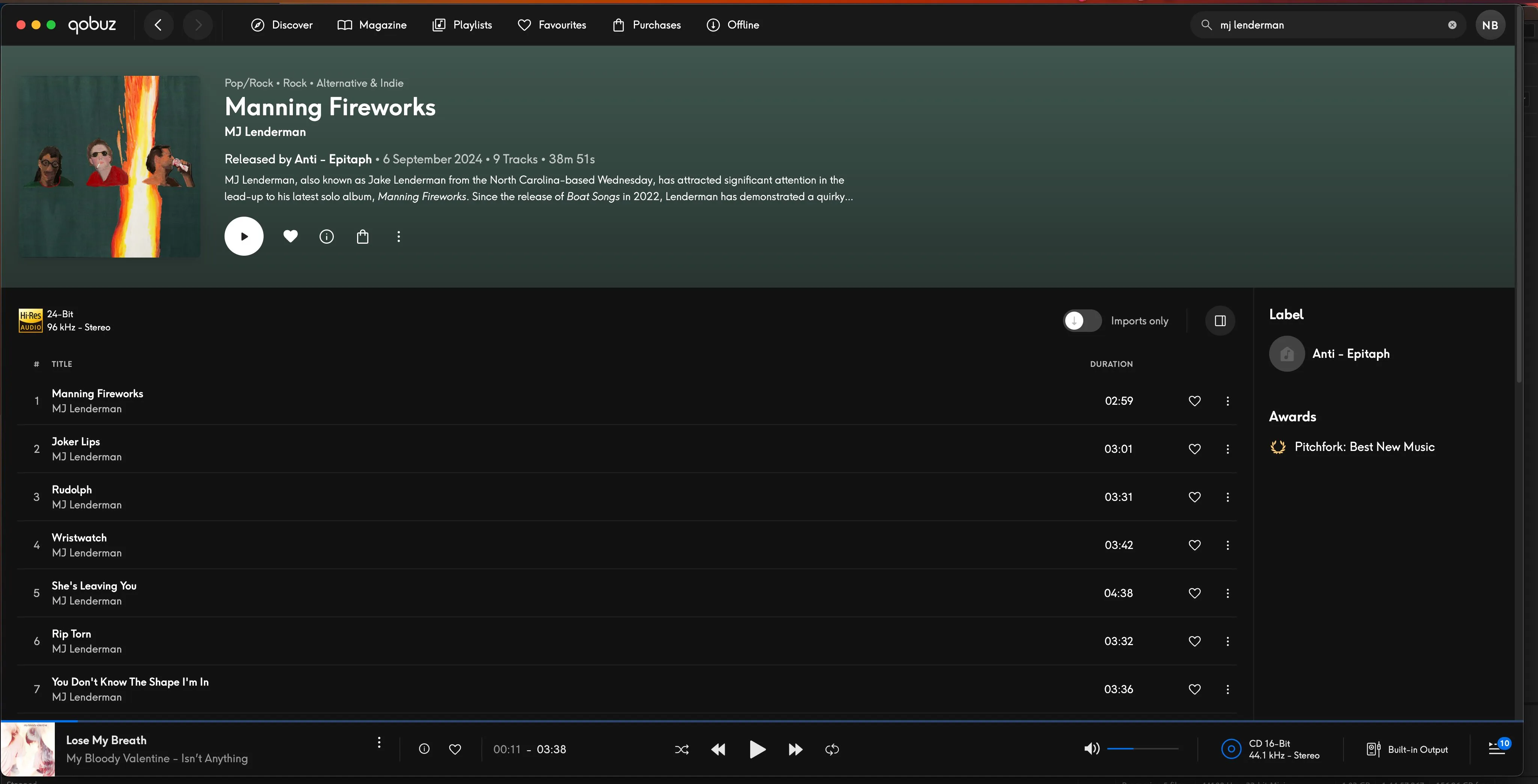
This contextual written focus is one of the most impressive things about the service compared to Spotify, though some other streaming services do offer it – I find Qobuz to be the best at it.
Spotify is big on meta data and prominent at showing lyrics, but Qobuz is really about offering editorial context – it is a platform with a critical point of view.
The sensibility to offer this background information highlights the difference between music as passive audio content and active discovery of art.
Qobuz is very much aimed at someone who wants to discover albums, and to that end it offers over 500,000 album reviews – when present, it is available at the top of each album page.
That’s in stark contrast to Spotify where single tracks and playlists rule the roost, Qobuz is a return to a different time – but also one more readily values and showcases the release catalogue of artists, and is reflective of a desire in the music culture to go deeper and listen more intently than whatever a platform serves up.
I’ve had this feeling that albums have become more dominant lately, a reaction to the overload and emphasis of single tracks and AI slop. The album is an intentional creative work, a body of art. It isn’t usually knocked out in 10 minutes on some Suno account.
The album reviews offer informational and critical context written by Qobuz staff, All Music/tivo, and it’s not all glowing words about every release.
The context is very useful when you are browsing and discovering the back catalogue of artists, and most artist pages usually includes a biography from All Music also.
I was struck recently by the accompanying text on Cocteau Twin’s Heaven or Las Vegas album page, which contextually presents its release as an unlikely achievement when most people were expecting the band to breakup, for example. Instead, they released the most lauded album in their discography.

In addition, a Magazine section offers a Bandcamp Daily style overview of the current month’s releases – this week’s best albums, with interviews and focus articles on labels, genres and sounds.
Sound quality Hi-res options
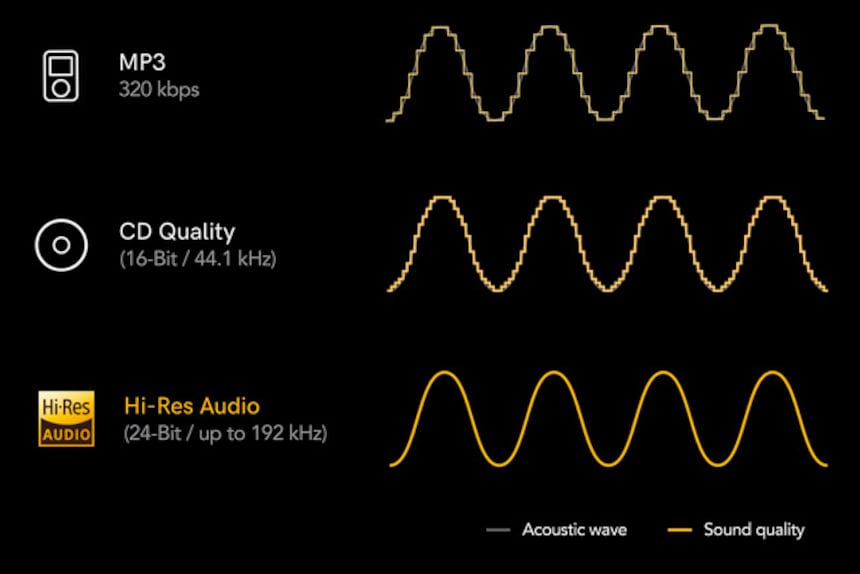
It’s baked into the app on mobile and desktop – the option to stream in various qualities – Qobuz uses FLAC for both CD-quality and hi-res audio, offering tracks up to 24-bit/192kHz.
You can stream in the following qualities:
- Hi-res 24 Bit / up to 192kbps
- Hi-res 24 Bit / up to 96kbps
- CD quality 16 bit / 44.1Hz
- MP3 320kbps
For comparison, Spotify’s Very High option is the equivalent of the Qobuz’s lowest tier, though Spotify have just launched their Lossless tier for Premium users this month – promising 24 Bit / up to 192kbps.
Spotify’s new tier also highlighted how Qobuz has been doing this since 2007 – and inadvertently highlighted how Spotify hadn’t for many years.
Qobuz said that signups to the service have actually increased 500% since Spotify revealed its lossless tier and its US student rate of $4.99/€5.99 a month can’t have hurt.
Anecdotally, I directly compared the difference between Qobuz’s lowest tier and Spotify’s Very High streaming quality playing The Prodigy’s Music for the Jilted Generation in the lead up to our album listening party this past July and Qobuz’s quality had a stark warm clarity that Spotify’s lacked (Spotify’s setting can default to a 24kbps setting at a weak connection which doesn’t help but you can change the auto-adjust quality so this doesn’t happen).
All of this means very little if you’re playing it out of your phone speaker or a mono Bluetooth device but it’s great when you’ve got a decent hi-fi system.
But having the audio stream quality options right there on the Now Playing page is very handy when you need to change the quality if your internet lags or WiFi doesn’t reach parts of your house.
For example, the internet connection to the kitchen in my house is temperamental as the signal passes through walls, so i’ll often choose CD quality or MP3 over the higher-res options if I’m listening in there – that option is super handy and my choice which I like.
A streaming service that encourages purchasing
Qobuz has a download store and purchase links for buying the hi-res files on every release it offers in its catalogue, meaning you can support the artist directly from the app, and own the music yourself, something which is going to be become increasingly important for the music you love, as artist catalogues disappear from platforms for the aforementioned reasons.
Playlists and radio
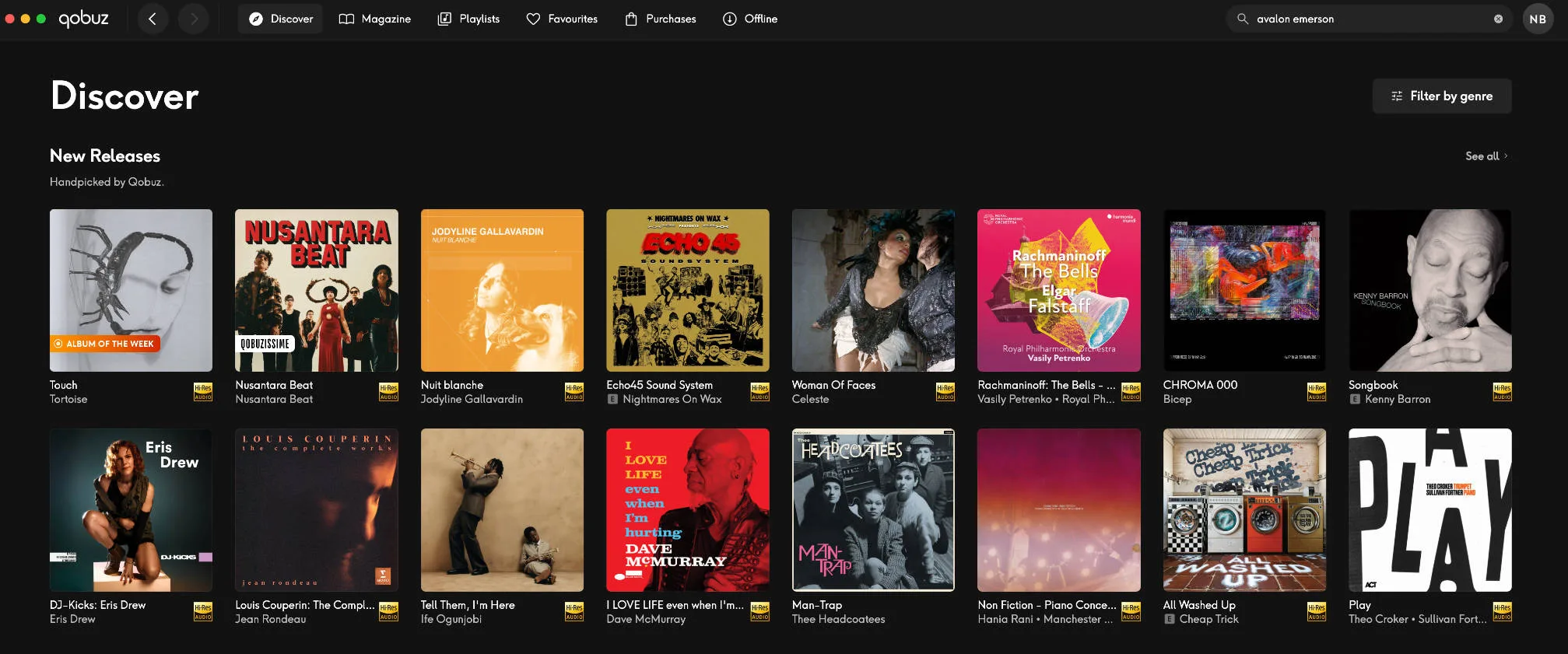
Every Friday, a curated list of new albums appear on the Discover tab – drawn from a wide array of genres – alternative and indie, classical, experimental, jazz, hip-hop and electronic are to the forefront, and you can drill down via genre – soul/funk/R&B, reggae, pop/rock and a children section too (as a recent new dad I appreciate it)
The Qobuz Playlists are also “curated by experts” and categorised by genre, mood (Mostly Spotify lifestyle fare like Autumn Daydreams, Cocooning On A Rainy Day but also Rap From Beyond The Grave – a playlist of macabre hip-hop), focus (Japanese Folk 1960-70s, 80s rock, dancefloor anthems, West Coast Jazz), hi-res, labels, artist playlists (with a written introduction) and “test your speakers” section among others.
It’s less popular chart driven – the equivalent of HMV vs Tower Records with prominent jazz and hi-fi sections, in terms of how it is pitched in the UI. And there are no public track stream numbers or follow counts either.
The only “charts” are in Discover showing top Albums in the community, which this week includes Rosalía’s Lux, Mavis Staples’ Sad And Beautiful World, CMAT’s Euro-Country, and Tortoise’s Touch.
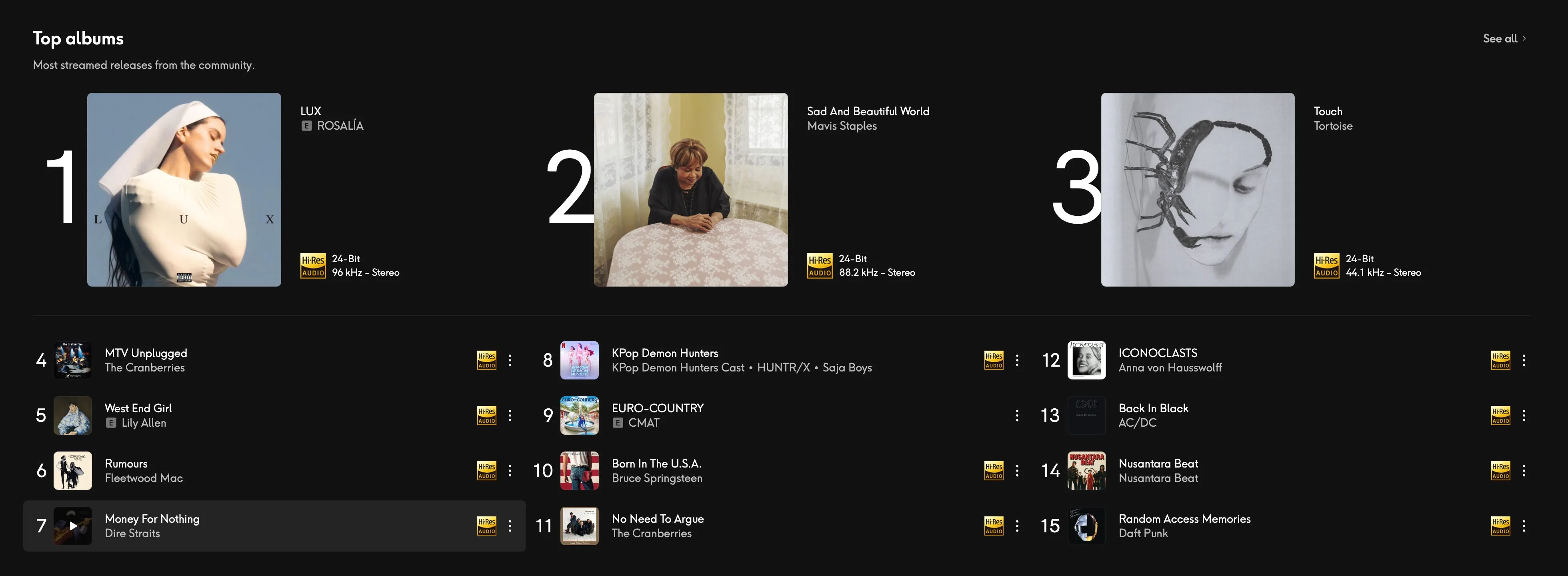
There is a space for individual song radio features and it is on artist pages but it hasn’t been great matching some choices I’ve tried out, like Italo.
The social ability to see what others are listening to isn’t present.
I’ve never been much of a Discovery Weekly fan – its suggestions never matched or helped me discover a great deal – I’d be more likely to dip into Spotify’s specialist playlists like Pollen, Hot New Bands, Daily Mix when I’m stuck, or other user playlists from people whose taste I like. Qobuz’s Daily Mix equivalent DailyQ (and its weekly equivalent WeeklyQ) shows mostly quite old music from artists I follow and related acts.
I’m aware that others may not use the Release Radar as much as I do, it’s Spotify’s best playlist feature for me – and while Qobuz has an extensive new release section, its Release Watch section is not playlist-based so doesn’t really pick up the single releases in the same way that Release Radar does, and it’s only available on the mobile app for now. That said..
It’s improving all the time
When I joined earlier in the year, Qobuz didn’t have great cross-platform support you couldn’t pick up where you left off on your phone on a desktop. That’s all fixed now with the launch of Qobuz Connect earlier this year, which this you can listen seamlessly from car to laptop with ease.
The UI is fine – some play buttons are a bit small and fiddly and there, but nothing that bothers me much. And some artist names have shown up backwards on profiles I noticed.
Qobuz is also now on Google TV with its own app as of this month with the caveat Android TV’s audio system resamples output to 48 kHz.
Spotify vs. Qobuz comparison chart
| Spotify | Qobuz | |
|---|---|---|
| Audio quality highest | Recently launched Lossless 24 Bit / up to 192kbps version to compete | Hi-res 24 Bit / up to 192kbps |
| Audio quality lowest | Just says 24kbps – no further information available. | Mp3 320kbps |
| Free tier | Ad-supported / limited features | Paid only |
| Editorial | Limited to Spotify playlists curated by in-house staff. No written words or articles. | Extensive, with album reviews, biographies, articles, recommendations, interviews and more |
| Ethical ownership (via Ethical Consumer Magazine) | Ethiscore 4/100 | Ethiscore 60/100 |
| Artist renumeration | Inferred. $0.003 to $0.005 per stream. 70% to the rights holders and 30% to Spotify. | Qobuz is transparent. US$0.01873 per stream. 70% of the revenues generated are paid to rights holders / 30% to Qobuz. |
| Catalogue | Over 100 million tracks plus Podcasts and audiobooks. | Over 100 million tracks. Good on jazz and classical but has everything I’ve looked for. |
| Discovery | Algorithmic and Editorial staff playlists. When it’s good, it’s very good. | Staff playlists and extensive editorial content, limited algorithmic usage through its personalised For You section. |
| Last FM scrobbling | Yes | Yes |
| Price | Free – ad supported Premium Individual – €11.99 a month Premium Duo – €16.99 a month Premium Family – €19.99 a month Premium Student – €6.99 a month | Premium (Studio) – €12.49 a month Studio Duo – €17.50 a month Family – €20.83 a month Student – €5.99 a month Sublime – €16.66 a month – Discounts on Hi-Res purchases of up to 60% |
| Bonus | No Joanna Newsom | Has Joanna Newsom |
| Best for… | The casual passive listener. | Audiophiles, new music deep divers and ethically-concerned listeners. |
A final note
This is a direct comparison between two distinct streaming platforms I will say, in the past the I tried Tidal – I just felt like I wanted more of a change from Spotify’s offering and it felt quite similar, Apple Music is clunky, slow and harder to navigate and I have a Youtube Premium account mostly to get rid of ads not to use their music service.

Niall Byrne is the founder of the most-influential Irish music site Nialler9, where he has been writing about music since 2005. He is the co-host of the Nialler9 Podcast and has written for the Irish Times, Irish Independent, Sunday Times, Totally Dublin, Cara Magazine, Red Bull and more. Niall is a DJ, co-founder of Lumo Club, event curator, Indie Sleaze club promoter, and producer of gigs and monthly listening parties & events in Dublin.






I have been using Qobuz since 2013 and absolutely love it! I also use Tidal and Presto Music. Qobuz is wonderful and I am thrilled with Qobuz connect! Thanks for posting.
I signed up a few months ago, having dropped my Spotify premium a bit before that, and I really like it. The search can be a bit finicky sometimes (it won’t find some tracks, but if you know the album and go to it, the track is there) but I really like having albums recommended to me with a little editorial about them. It feels so curated rather than just a random “here’s what the labels are paying us to promote.”
that’s it Orlaith. It feels like there’s people behind those pages.
One of the few downsides of leaving Spotify for quboz, the nialler9 playlists!